


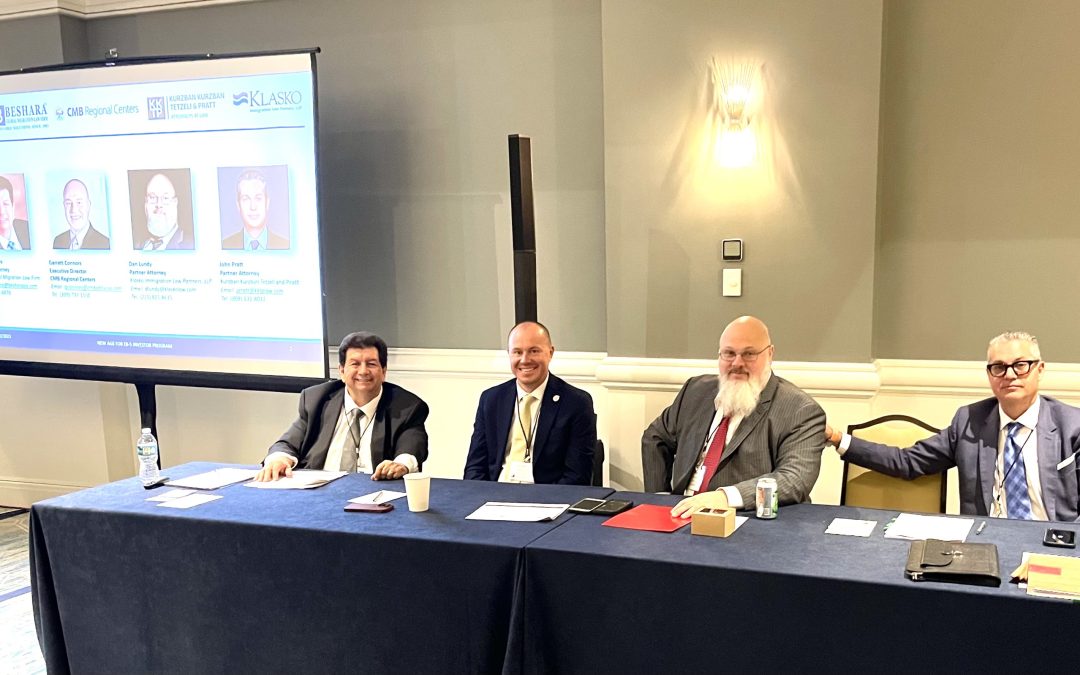
AILA Central Florida Annual Conference (10/18-10/20)
CMB Executive Director Garrett Connors speaks at the annual AILA Central Florida conference


CMB Executive Director Garrett Connors speaks at the annual AILA Central Florida conference

Discover the benefits of the EB-5 investor visa program
In 1990, the United States Congress created the EB-5 Immigrant Investor Program. This visa category is targeted towards qualified foreign nationals seeking to obtain lawful permanent residency by investing in the U.S. economy and creating at least 10 full-time U.S. jobs. Currently, the program is administered by U.S. Citizenship & Immigration Services (USCIS). The required investment is $1.05 million, but can be reduced to $800,000 if the target investment occurs in a targeted employment area (TEA), which is defined as a rural or high unemployment area.
In 1992, Congress created an additional component of the standard EB-5 program, the Regional Center Pilot Program. A Regional Center is a private or public entity designated by USCIS that is authorized to coordinate with multiple immigrant investors and to pool their investments for greater economic impact. Regional Centers are authorized to operate within defined geographic regions that require approval by the USCIS through a rigorous application process. These Regional Center geographic scopes can be cities, counties, or entire states.
There are several differences between the standard EB-5 program and the Regional Center Program. The Regional Center Program allows the use of economic modeling to determine the direct, indirect and induced job impacts related to each investor’s capital contribution. This means that in the Regional Center Program, the EB-5 participant (investor) can count direct, indirect, and induced job creation as a result of their EB-5 investment. The Regional Center operator benefits investors by conducting all the upfront due diligence, underwriting, and managing of the EB-5 investment through all stages of the investment and immigration process.
There are several steps in the EB-5 immigration process for an investor to earn a green card. Once the investor selects a regional center and project, the investor would then work with their immigration attorney to file their I-526E petition requesting conditional residency. The USCIS then reviews and determines whether the investor and qualifying family members qualify for the conditional EB-5 visa(s). This part of the process includes a detailed review of the sources of the investor’s funds, family history, and other representations of the investor and family members included in the petition. This petition, (through association to the regional center’s I-956F petition) also includes a thorough description of the EB-5 investment project and any economic models used to determine job creation. If approved (an I-526E petition approval), the investor will schedule a consular interview to then receive a conditional green card that is valid for two years. Then the investor and family would declare residency in the United States.
Near the end of the two-year period of conditional residency, the investor’s immigration attorney would file another petition with USCIS to remove their conditions (Form I-829). This petition demonstrates that the EB-5 participant’s capital was fully invested and at risk during the two-year period and that the requisite 10 qualifying jobs have been created. Upon approval of the I-829, the investor and family members become lawful permanent residents and can ultimately choose to become U.S. citizens.
The U.S. EB-5 visa is a permanent visa and requires no future re-qualification, offering more advantages and fewer constraints than any other visa program in the world. The EB-5 visa has no requirements regarding age, business training, management skills, experience, or language skills.

After 5 years of residency visa holders can apply for U.S. Citizenship.

Visa holders have the freedom to live anywhere in the U.S. and there is no requirement where you have to live based on the EB-5 project’s location.

Green card holders may attend U.S. schools at the same cost as citizens. The U.S. has some of the highest rated schools and universities in the world.

Visa holders can work anywhere without an employer sponsor or start their own business anywhere within the U.S. 50 states and its territories.

STEP 01
A potential investor interested in the EB-5 program should begin by conducting due diligence on available EB-5 projects, regional centers, and immigration attorneys. The EB-5 process takes years to complete; it is important that the investor is comfortable with their choice in all three areas.

STEP 02
Once the investor selects the regional center and EB-5 project, they will need to work with their immigration attorney to ensure the source of their investment funds will be acceptable to the USCIS. In CMB EB-5 Partnerships, our administrative placement agent will review the investor’s suitability and compliance with applicable securities laws. The investor will then transfer their funds.

STEP 03
Once subscribed to an EB-5 partnership, the investor will be able to work with their immigration attorney to file their first immigration petition with the USCIS: the I-526E petition for conditional permanent residency. The USCIS will adjudicate this petition to determine that the investor’s source of funds is acceptable, and (through association to the regional center’s I-956F petition) that the EB-5 investment is likely to meet all EB-5 requirements.

STEP 04
When the I-526E petition is approved, the EB-5 investor applies for conditional residency through a consulate interview (or an adjustment of status, if he or she is already in the U.S. on another visa).

STEP 05
Once the investor is approved for a visa and a visa is available, the investor and qualified family members are issued conditional green cards that are valid for two years. The EB-5 investor must enter the U.S. within 180 days if they are not already in the U.S. This entry into the U.S. then begins a 24 month period of conditional permanent residency.

STEP 06
Between months 22-24 of the EB-5 investor’s conditional permanent residency period, the investor’s immigration attorney files the I-829 petition to remove the conditions on the green card and achieve permanent residency. The USCIS will adjudicate this petition to determine that all requirements were met, and all requisite jobs were created.

STEP 07
In CMB EB-5 partnerships, once all outstanding investments have been returned to the partnership, and immigration goals have been met, the balance of each investor’s capital account can be returned according to the Partnership Agreement.
In 1992, Congress created an additional component of the EB-5 program, the Regional Center Pilot Program. A Regional Center is a private or public entity designated by USCIS that is authorized to coordinate with multiple immigrant investors and to pool their investments for greater economic impact. Regional Centers are authorized to operate within defined geographic regions and within specific industry sectors.
There are several essential differences between direct EB-5 and the Regional Center Program. The Regional Center Program allows for the use of economic modeling to calculate the indirect and induced job creation related to all spending for each project. This means that in the Regional Center Program, the EB-5 investor can rely upon direct, indirect, and induced jobs to meet the job creation requirement of the EB-5 program.
Regional Center EB-5 investments, like those offered by CMB, usually take the form of a limited partnership. Immigrant investors pool their investment funds to either lend or make an equity investment typically for a large-scale commercial project. Regional Center investments are able to utilize economic modeling to claim direct, indirect, and induced job creation to satisfy the EB-5 requirement of 10 new American jobs per investor.

Direct EB-5 investments can only utilize direct job creation to satisfy EB-5 requirements. This means that the target project must directly support at least 10 full-time employees per EB-5 investor for a minimum of two years. A direct EB-5 investor must submit documents (payroll information and proof of citizenship) for each employee with their immigration petition. Additionally, as of 2022, a direct EB-5 investment project can only be associated with one EB-5 petition.
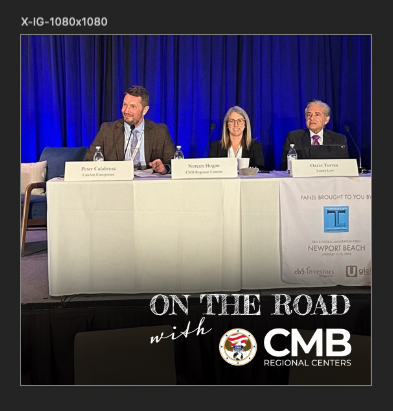
ON THE ROAD with CMB! Noreen Hogan, President of CMB Regional Centers, shared insights on the EB-5 program at the 2024 EB-5 & Global Immigration Expo in Newport Beach today. Her panel focused on strategies to evaluate EB-5 investment projects.
Effective Date June 9, 2022
Our goal in collecting visitor information online or in person is to provide the best experience possible, through delivering relevant information that meets user needs and/or to allow us to provide the Services. We have collected one or more of the following types of personal information within the last twelve (12) months:
If you are a resident of the State of California, under the California Consumer Privacy Act you have the right to request that we disclose certain information about our collection and use of your personal information over the past 12 months. Once we receive and confirm your verifiable consumer request, we will disclose to you:
We may deny your deletion request if retaining the information is necessary for us or our service provider(s) to:
To exercise the access, data portability, and deletion rights described above, please submit a verifiable consumer request to us by either:
Only you, or someone legally authorized to act on your behalf, may make a verifiable consumer request related to your personal information. You may only make a verifiable consumer request for access or data portability twice within a 12-month period. The verifiable consumer request must provide sufficient information that allows us to reasonably verify you are the person about whom we collected personal information or an authorized representative, which may include:
Additionally, the verifiable consumer request must describe your request with sufficient detail that allows us to properly understand, evaluate, and respond to it. We cannot respond to your request or provide you with personal information if we cannot verify your identity or authority to make the request and confirm the personal information relates to you. Making a verifiable consumer request does not require you to create an account with us. We will only use personal information provided in a verifiable consumer request to verify the requestor’s identity or authority to make the request.
Colorado, Virginia and Utah each provide their state residents with rights to:
Colorado and Virginia also provide their state residents with rights to:
To exercise any of these rights please either email us at: [email protected] or call us at: (800) 870-0702. To appeal a decision regarding a consumer rights request, such submissions should be provided in writing via the email above, which shall be reviewed by the Company and determined what portion, if any, such rights will be sustained in our reasonable discretion.

CMB Regional Centers takes your privacy seriously
CMB Regional Centers collects and uses certain personal information, including through the use of cookies. Information collected through cookies is used to improve user experience on our site and analyze how it is used.
California residents have certain rights with regard to the collection and use of their personal information.
Please see our Privacy Policy for more information.