EB-5 Due Diligence: Why Waiting for I-956F Approval May Limit Your Options
In the competitive EB-5 marketplace, some Regional Centers, broker/dealers, and immigration placement agencies treat I-956F approval as the primary indicator of project viability.
However, as CMB Regional Centers (CMB) has previously indicated, the I-956F approval is the first step in an EB-5 immigrant’s journey, and project risk needs to be evaluated from a holistic perspective. For example, a project from an inexperienced Regional Center with a lingering I-956F approval that is struggling to raise the required investors likely carries more risk than a CMB project with a pending I-956F.
In fact, CMB projects that remained pending at the I-956F stage for longer than 90 days were, on average, 85% subscribed by the time United States Citizenship and Immigration (USCIS) approved the I-956F. Investors who wait for CMB I-956F approvals leave a very narrow window to evaluate and subscribe to the partnership.
Since the passage of the EB-5 Reform and Integrity Act (RIA), I-956F adjudication trends have moved through three general phases based on quarterly data from USCIS:
1.) Long waits following the passage of the RIA (2022 – 2023)
2.) A significant increase in I-956F completions and (2024)
3.) Production lags but remains consistent (2025 & Q1 2026)
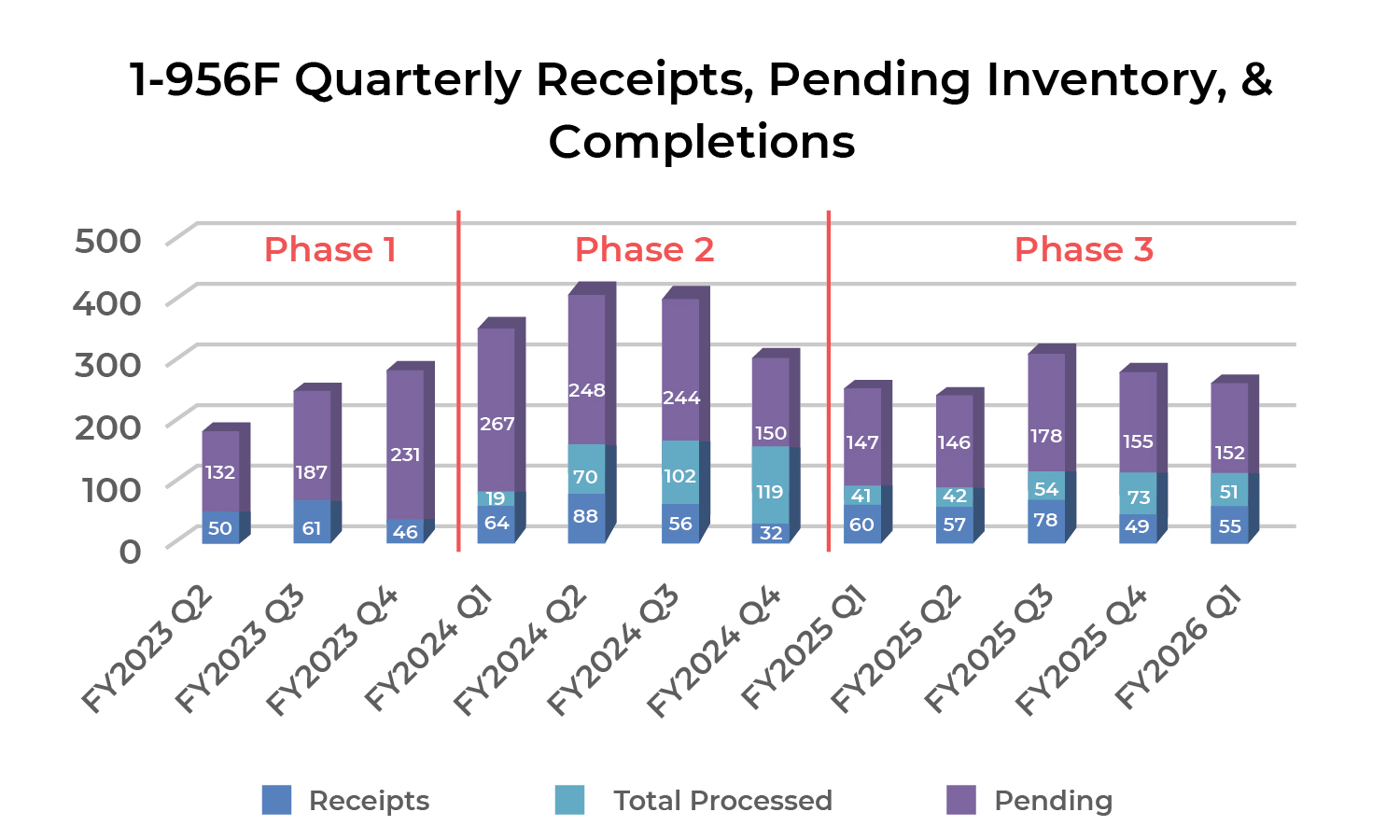
CMB started submitting I-956F petitions to USCIS as soon as possible in 2023 and 2024, but USCIS only began meaningfully adjudicating I-956F petitions in FY2024. As a result, many of the earliest CMB project petitions remained pending for more than a year. During this initial period (Phase 1), CMB projects observed an average wait time for I-956F approval of approximately 378 days.
In Phase 2, USCIS increased I-956F production, and processing times improved. Total completions reached a record 310 in FY2024. For CMB project I-956F petitions filed in FY2024, the average wait time for approval was 97.4 days—a significant decrease from the 378-day average in Phase 1.
Phase 3 is characterized by lower overall USICS production (210 completions in FY2025) but relatively consistent adjudications, averaging 52 per month between FY2025 Q1 and FY2026 Q1. During this period, CMB has averaged 123 days for an I-956F approval.
These trends illuminate important timing considerations for prospective EB-5 investors. As mentioned earlier, for CMB project filings that took more than 90 days to receive approval, the corresponding CMB partnerships were, on average, 85% full at the time of I-956F approval. In practical terms, investors who waited to subscribe to a CMB EB-5 project until the I-956F approval faced both a narrow window and a very limited amount of available units.
However, hope for a quality low-risk project is not lost for those investors who miss out. Since the passage of RIA, CMB has consistently maintained at least one active project available to prospective EB-5 investors and has generally offered multiple projects available at any given time. While some Regional Centers may file only one or two projects per year, CMB continues to evaluate prospective opportunities months or even years in advance in order to maintain a consistent pipeline of high-quality EB-5 projects.
This pipeline is underpinned by efforts from CMB’s own in-house Project Development, Legal, and Economics teams to thoroughly evaluate prospective opportunities before they are brought to market, with the goal of identifying EB-5 projects that meet CMB’s strict underwriting standards. Many projects CMB reviews never advance to market, and the decision to walk away from these potential EB-5 projects reflects our commitment to maintaining disciplined and conservative project selection standards. This has allowed CMB to maintain a 100% project approval success track record.
With demand expected to increase ahead of the grandfathering provision deadline on September 30, 2026, and a minimum EB-5 investment amount increase in January 2027, timing has real implications for prospective immigrants considering EB-5. For these prospective investors, the key takeaway is not to treat I-956F approval as the end-all-be-all for project review, but to appropriately weigh I-956F status as one important factor of many in a due diligence framework.
—
About A.J. Hogan
Economic Strategy and Data Insights Manager at CMB Regional Centers
During his tenure at United States Citizenship and Immigration Services (USCIS), A.J. helped shape EB-5 policy, adjudication practices, and economic evaluation standards.
In that role, he led a team of economists responsible for adjudicating EB-5 I-956F petitions and assessing the credibility of business plans and economic impact analyses.
A.J. also adjudicated the very first I-956F project petition and played a key role in policy updates, regulatory guidance, and public outreach efforts supporting the implementation of the EB-5 Reform and Integrity Act of 2022.
As Economic Strategy and Data Insights Manager at CMB Regional Centers, A.J. is focused on economic strategy, project vetting, policy integration, and data analysis.
—
More EB-5 Resources
About CMB Regional Centers
CMB has assisted over 7,000 investor families, from over 100 countries, in their pursuit of immigrating to the United States through America’s EB-5 Immigrant Investor visa program. CMB currently maintains a 100% project approval rate across more than 90 partnerships that have undergone USCIS adjudication.
To date, CMB has repaid over $1.5 billion USD to investors.