Loading...
A.J. Hogan, Author at CMB Regional Centers
EB-5 Due Diligence: Why Waiting for I-956F Approval May Limit Your Options

EB-5 Due Diligence: Why Waiting for I-956F Approval May Limit Your Options
EB-5 Due Diligence: Why Waiting for I-956F Approval May Limit Your Options


In the competitive EB-5 marketplace, some Regional Centers, broker/dealers, and immigration placement agencies treat I-956F approval as the primary indicator of project viability.

However, as CMB Regional Centers (CMB) has previously indicated, the I-956F approval is the first step in an EB-5 immigrant’s journey, and project risk needs to be evaluated from a holistic perspective. For example, a project from an inexperienced Regional Center with a lingering I-956F approval that is struggling to raise the required investors likely carries more risk than a CMB project with a pending I-956F.

In fact, CMB projects that remained pending at the I-956F stage for longer than 90 days were, on average, 85% subscribed by the time United States Citizenship and Immigration (USCIS) approved the I-956F. Investors who wait for CMB I-956F approvals leave a very narrow window to evaluate and subscribe to the partnership.

Since the passage of the EB-5 Reform and Integrity Act (RIA), I-956F adjudication trends have moved through three general phases based on quarterly data from USCIS:

1.) Long waits following the passage of the RIA (2022 – 2023)

2.) A significant increase in I-956F completions and (2024)

3.) Production lags but remains consistent (2025 & Q1 2026)
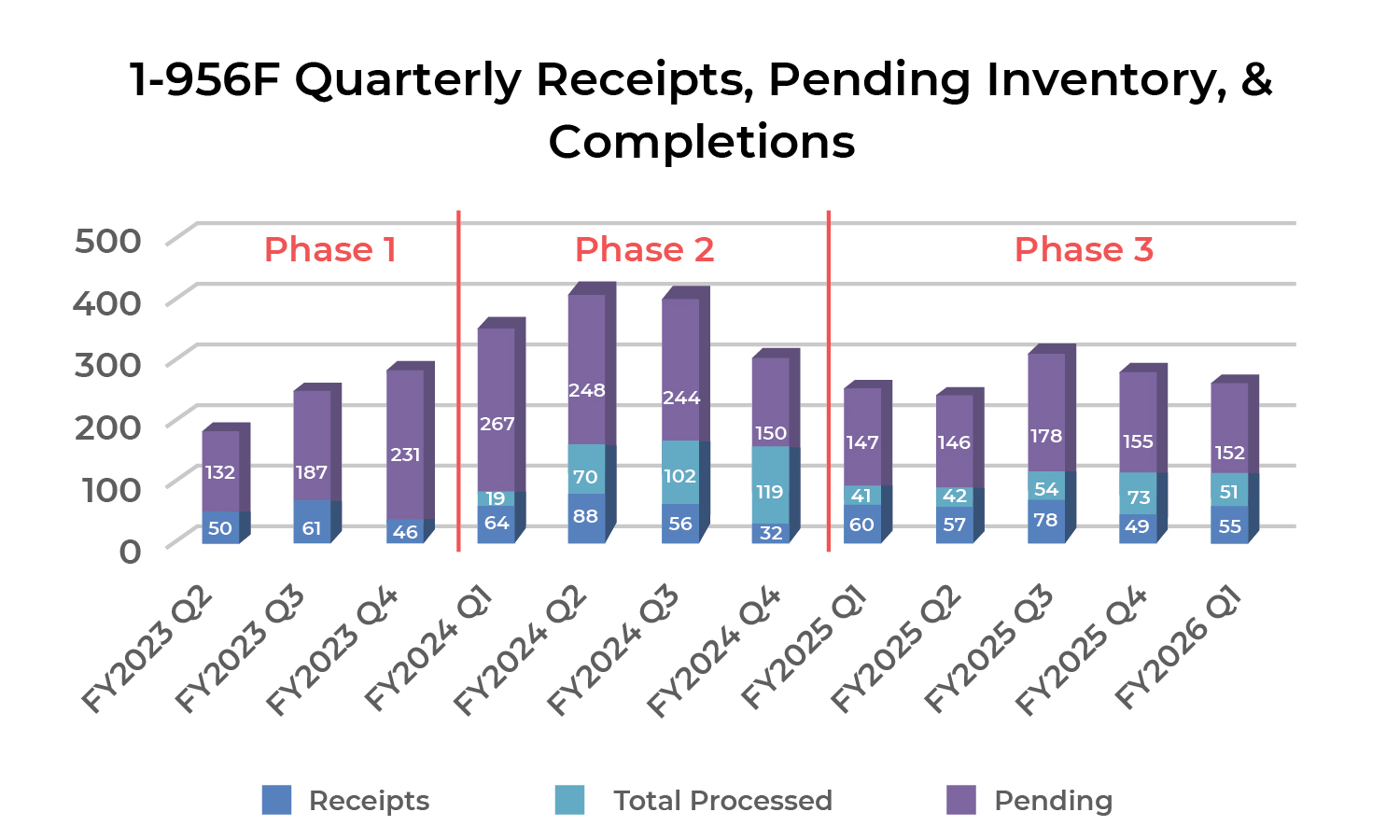
 

CMB started submitting I-956F petitions to USCIS as soon as possible in 2023 and 2024, but USCIS only began meaningfully adjudicating I-956F petitions in FY2024. As a result, many of the earliest CMB project petitions remained pending for more than a year. During this initial period (Phase 1), CMB projects observed an average wait time for I-956F approval of approximately 378 days.

In Phase 2, USCIS increased I-956F production, and processing times improved. Total completions reached a record 310 in FY2024. For CMB project I-956F petitions filed in FY2024, the average wait time for approval was 97.4 days—a significant decrease from the 378-day average in Phase 1.

Phase 3 is characterized by lower overall USICS production (210 completions in FY2025) but relatively consistent adjudications, averaging 52 per month between FY2025 Q1 and FY2026 Q1. During this period, CMB has averaged 123 days for an I-956F approval.

These trends illuminate important timing considerations for prospective EB-5 investors. As mentioned earlier, for CMB project filings that took more than 90 days to receive approval, the corresponding CMB partnerships were, on average, 85% full at the time of I-956F approval. In practical terms, investors who waited to subscribe to a CMB EB-5 project until the I-956F approval faced both a narrow window and a very limited amount of available units.

However, hope for a quality low-risk project is not lost for those investors who miss out. Since the passage of RIA, CMB has consistently maintained at least one active project available to prospective EB-5 investors and has generally offered multiple projects available at any given time. While some Regional Centers may file only one or two projects per year, CMB continues to evaluate prospective opportunities months or even years in advance in order to maintain a consistent pipeline of high-quality EB-5 projects.

This pipeline is underpinned by efforts from CMB’s own in-house Project Development, Legal, and Economics teams to thoroughly evaluate prospective opportunities before they are brought to market, with the goal of identifying EB-5 projects that meet CMB’s strict underwriting standards. Many projects CMB reviews never advance to market, and the decision to walk away from these potential EB-5 projects reflects our commitment to maintaining disciplined and conservative project selection standards. This has allowed CMB to maintain a 100% project approval success track record.

With demand expected to increase ahead of the grandfathering provision deadline on September 30, 2026, and a minimum EB-5 investment amount increase in January 2027, timing has real implications for prospective immigrants considering EB-5. For these prospective investors, the key takeaway is not to treat I-956F approval as the end-all-be-all for project review, but to appropriately weigh I-956F status as one important factor of many in a due diligence framework.

About A.J. Hogan

Economic Strategy and Data Insights Manager at CMB Regional Centers

During his tenure at United States Citizenship and Immigration Services (USCIS), A.J. helped shape EB-5 policy, adjudication practices, and economic evaluation standards.

In that role, he led a team of economists responsible for adjudicating EB-5 I-956F petitions and assessing the credibility of business plans and economic impact analyses.

A.J. also adjudicated the very first I-956F project petition and played a key role in policy updates, regulatory guidance, and public outreach efforts supporting the implementation of the EB-5 Reform and Integrity Act of 2022.

As Economic Strategy and Data Insights Manager at CMB Regional Centers, A.J. is focused on economic strategy, project vetting, policy integration, and data analysis.

More EB-5 Resources

About CMB Regional Centers

CMB has assisted over 7,000 investor families, from over 100 countries, in their pursuit of immigrating to the United States through America’s EB-5 Immigrant Investor visa program. CMB currently maintains a 100% project approval rate across more than 90 partnerships that have undergone USCIS adjudication.

To date, CMB has repaid over $1.5 billion USD to investors.
Navigating Project Selection: Evaluating EB-5 Projects with Pending vs. Approved I-956F Petitions

Navigating Project Selection: Evaluating EB-5 Projects with Pending vs. Approved I-956F Petitions

Navigating Project Selection: Evaluating EB-5 Projects with Pending vs. Approved I-956F Petitions

A metaphorical take on strategic differentiation between a pending and approved I-956F


One prevalent misconception in the EB-5 industry, since the passage of the EB-5 Reform and Integrity Act of 2022 (RIA), is that an EB-5 project with an approved I-956F is lower risk than a project with a pending I-956F. In the opinion of this author, it is much more important for potential investors to evaluate risk from a totality perspective than through the narrow scope of I-956F approval on its own.

For an illustrative example: think of your immigration journey as taking a voyage across an ocean to reach your final destination (aka permanent Green Card). However, every voyage must start this journey at the dock, evaluating potential ships (projects) to take you across the ocean (EB-5 immigration process).

United States Citizenship and Immigration Services (USCIS) issues gangway planks for boarding (I-956F approval).

Looking out at the open water ahead, you might see storm clouds gathering. These clouds could take the form of economic downturns that impact project viability, program expiration risk, and regulatory changes, to name a few. Choosing the right boat at this stage can make all the difference later down the line.

At the dock, the first boat you come across is the SS Rural Regatta which advertises “I-956F approved, board now!” However, the boat is a 15-foot, single engine, center console, with a crew of two: a captain and first mate. This boat might be able to make the journey across the ocean for you, but the conditions must be perfect. Ask yourself: how is it going to fare if any storm squalls come along? Will the boat take on water? Will it be a bumpy and stressful ride in open-air? Has the captain even undertaken this journey before?

Across the dock, you see the USS CMB, a tried-and-true yacht with years of seafaring experience, but the sign above it says “I-956F pending.” Even though the I-956F is pending, people are queuing up already, just waiting for the harbormaster to lower the gangway plank (issue the I-956F approval). Dozens of crew members are working hard to prepare for the voyage, and the captain has made this journey almost 100 times. All of this indicates that this ship is as equipped as possible to navigate any unforeseen storms ahead.

When the harbor master finally lowers the gangway plank (I-956F approval), it already might be too late, as there’s a queue of travelers who waited until this moment to try and board. The savvy travelers secured their spot because they already recognized the strongest ship (with the most experienced crew and captain) that will provide the best odds of reaching their final destination.

It is important to remember that USCIS adjudicates the I-956F at the preponderance of the evidence standard, which is the lowest threshold of proof in the United States legal system. This means that USCIS only has to come to the conclusion that the project is “more likely than not” or have a “fifty percent and a feather” chance at success to happen, based on the business plan. That’s slightly more likely than guessing correctly on a coin flip. This is why some of the “boats” might be advertising I-956F approval but not even appear seaworthy (capable of completing the project). If an adjudicator thought that the project had a 49.9% chance of failure, they are still required by law to approve the I-956F petition.

Beyond the metaphor, understand that your outcome depends on much more than an I-956F approval alone. A Regional Center’s track record, coupled with the developer’s execution history, are far more predictive of outcomes. These factors ultimately contribute to a successful investment and smooth immigration process for you and your family.

About A.J. Hogan

During his tenure at United States Citizenship and Immigration Services (USCIS), A.J. helped shape EB-5 policy, adjudication practices, and economic evaluation standards.

In that role, he led a team of economists responsible for adjudicating EB-5 I-956F petitions and assessing the credibility of business plans and economic impact analyses.

A.J. also adjudicated the very first I-956F project petition and played a key role in policy updates, regulatory guidance, and public outreach efforts supporting the implementation of the EB-5 Reform and Integrity Act of 2022.

As Economic Strategy and Data Insights Manager at CMB Regional Centers, A.J. is focused on economic strategy, project vetting, policy integration, and data analysis.

About CMB Regional Centers

CMB has assisted over 6,900 investor families, from over 100 countries, in their pursuit of immigrating to the United States through America’s EB-5 Immigrant Investor visa program. CMB currently maintains a 100% project approval rate on all 93 partnerships that have undergone USCIS adjudication.

To date, CMB has repaid over $1.5 billion USD to investors.
 

More EB-5 Resources

Redefining Due Diligence in Today’s EB-5 Landscape

Redefining Due Diligence in Today’s EB-5 Landscape

This whitepaper from CMB Regional Centers, one of the most experienced Regional Centers in the EB-5 industry, aims to clarify what I-956F approval actually means and, more necessary than ever, to clarify what it does not mean. The authors of the piece examine the dimensions of due diligence that determine whether an EB-5 investment is likely sound and propose a framework for investors and their advisors to pressure-test project quality in a market where compliance and competence are too often treated as synonymous.

In this whitepaper, you’ll learn:

  • What I-956F approval actually means and why it’s only the starting point of due diligence

  • The two biggest marketing misinterpretations distorting today’s EB-5 market

  • How to evaluate whether a project is truly ready to break ground (not just marketed that way)

  • The capital stack red flags that signal higher risk for EB-5 investors

  • Why developer experience, insurance, and completion guaranties matter more than speed

  • The questions every investor should ask before subscribing, regardless of project designation

*By submitting your email address, you agree to receive marketing communications from CMB Regional Centers. You can unsubscribe at any time by clicking the link in our communication or by verbally requesting to unsubscribe from communications from CMB Regional Centers. See our Privacy Policy for details on how we handle your data.

About CMB Regional Centers

CMB has assisted over 6,900 investor families, from over 100 countries, in their pursuit of immigrating to the United States through America’s EB-5 Immigrant Investor visa program. CMB currently maintains a 100% project approval rate on all 93 partnerships that have undergone USCIS adjudication. CMB EB-5 partnerships are projected to have created more than 215,000 American jobs.

To learn more, contact CMB directly at [email protected].

CMB Logo

Data Privacy

CMB Regional Centers takes your privacy seriously

CMB Regional Centers collects and uses certain personal information, including through the use of cookies. Information collected through cookies is used to improve user experience on our site and analyze how it is used.

California residents have certain rights with regard to the collection and use of their personal information.

Please see our Privacy Policy for more information.